The origins of "ma'am" and "sir" are pretty self-explanatory. "Ma'am" comes from the more formal "madam," a term of address once used for a married woman. "Sir," besides being what folks called knights in merry old England, became a catch-all for addressing a gentleman.

Both have been historically used to address people of a certain age without using given names. They are, most certainly, a gesture of respect. I'm convinced, too, that we say them more in the South because we're a friendly bunch and tend to talk to strangers. My personal recommendation for what the nonbinary equivalent of 'Ma'am' or 'Sir' could be. This could always change, but I've been thinking about this for a long time and I think for right now where I am this is what I really do want to recommend to people.

A better solution might be to remove gendered forms of address altogether, but I don't know if that's a realistic request to make. Plus there are many binary trans people who rely upon binary-gendered terms to validate themselves; and I think that's equally important and worth supporting. This is likely why nonbinary trans people like me often try to provide alternatives. It's easier to start to introduce ourselves to the masses in ways that can be more quickly understood.

Regardless, I hope this small collection and discussion of language has proven helpful as a springboard for understanding the reality and variation within nonbinary trans people's needs. There are many ways people do this — I myself tend to play with words by adding the letter "X" to them for this reason — and this is why sometimes you may come across words you've never seen before. Not all nonbinary trans people have an interest in NEL, because not all trans people want to be capital O Out all the time. However, it is nice and good sometimes to know that you don't have to grasp onto words that weren't really made for you like a last minute addition, and that there are exclusive terms there if you want them.

To answer the main question that sparked this entire piece, we first have to explore and understand a different aspect of language we currently utilize. An honorific is a title that is placed before a person's name either to explain their rank, role, marital status, or assumed gender. You may also know your honorific under the term "suffix". All the mail you receive tends to include an honorific attached to the front of your name.

Honorifics in general have also influenced a good bit of gendered language and the way we refer to other people. You've probably answered the question as to what your title, honorific, or suffix is hundreds of times. Many people don't even realize how difficult this question can be for nonbinary people when a non-gendered option is not provided.

The reason we have different variants of any word is because not all speakers communicate with all other speakers of their language. Words and sounds all shift over time but they're on a continuum rather than poles. Although the typically-American 'mom' is used in the Midlands in the UK, it's not as though there is a physical border to separate the usage.

Speakers around the Midlands border also use a mix of 'mom' with the open vowel and 'mum' with the open-mid vowel. The use of dialects is not restricted to geographical borders. The use of sir and ma'am as forms of address for superiors are common in the United States armed forces. Air Force regulations state that ma'am is an appropriate greeting for junior personnel when rendering a hand salute to a female superior.

Gender neutral language has existed as long as language has existed. In fact, neutral terms often come before gendered ones. Especially when language was first developing, human beings were far more likely to think of others as a "person" than as a "man" or a "woman". GNL is very important both in the perspective of de-centering masculinity and men as the origin and the default as well as being intentionally inclusive of all those who are neither men nor women. Just as 'gender non-conforming' is a description that can apply to anyone who does not conform to gender roles — cis or trans — gender neutral language acts similarly. It's for everyone and does not inherently mean or imply nonbinary-ness.
Being nonbinary is something separate from generic gender-neutrality. It is a necessary tool for anyone who uses language but especially for anyone trying to ensure they refer to the nonbinary trans people in their lives and in the world properly. However, this is not the only sort of language that exists for this purpose. One possible reason for the difference between the 'o' and 'u' of the more common 'mom' and 'mum' may be the Great Vowel Shift .

The Great Vowel Shift was a major change in pronunciation in England and is the reason many of our words have irregular spellings. Vowel sounds changed in the GVS from 1350 and 1700 so it's not out of the realm of possibility that America, as a new nation, got the tail end of the shift in pronunciation. For instance, 'my' used to be pronounced /mi/ but the /i/ sound changed to /ai/ to give us the Modern English 'my'.

However, knowing that we had 'mama' since the early 1700s, at the end of the Great Vowel Shift, it seems unlikely that the GVS is the source of divergence between 'mom' and 'mum'. I'm flummoxed by the comments here because "ma'am" (and "mam") sounds completely rude to me. It sounds like an anachronistic insult and vaguely condescending.

I have a PhD but do NOT expect or like people to use any honorifics for that–they can just use my freaking first name (or "Dr." for formal business correspondence if they have to). "Ma'am" conjures the patriarchy, feigned deference, unwarranted respect, ageism, etc., etc. It's a relic, and I'll be happy to see it go. I think you misunderstand that men would have taken the same offense as the women did in the given examples. In military settings it is customary during conversation to address superior officers "Sir" or "Ma'am" instead of their rank.

Some female officers feel there is a taint of inferiority suggested with "Ma'am" and prefer that their rank be acknowledged. Male officers do not feel this inferiority about "Sir," but I think it likely that rank will become the preferred form of address as our culture continues its trend toward gender non-specific job titles. The British use 'mam' to address their mothers and 'ma'am' is the shortened form of madam. A lot of people use 'mam' rather than using 'ma'am'; the latter is the correct way to address a lady when you are writing her a mail. Ma'am is just a shortened version of the word madam.

It is used without someone's name as a sign of respect. It is also considered a polite way to address a woman. However, some women consider being called ma'am offensive or rude. Ma'am is somewhat outdated honourific and a contraction of madame.

It is a sign of respect and should never cause offence. It is usually reserved for older or married women and today may not be in common usage, depending on where you live. I expect you are correct in thinking it makes a person feel old. Now that we've established the two main families of nonbinary friendly language, let's form a mini-glossary of terms and words that can be used! This is just a very small sampling of a fraction of all the terms that are out there, but these are a few of the terms I feel are best to learn first. Keep in mind that every nonbinary individual is different.

Always ask a nonbinary trans person before you call them something. 'Mamma' transformed orthographically over time and 'mama' appeared in the early 1700s possibly as a misspelling or a slight change in pronunciation. It wasn't until a few years later in the United States that 'mommy' was used in 1844 and 'momma' in 1884. It's interesting to note that it was in less than 45 years that five out of six of these terms for mother came about.
I find it a bit strange that any female senators/officers/etc. A man holding the same title might sometimes be called "sir", so for a woman to sometimes be called "ma'am" is the same thing, right? "Ma'am" isn't replacing the title; it's just the honorific. Where I come from, children are taught that responding to grownups with a mere "yes" or "no" is impolite.

As a child I was taught to say "yes, sir, no, ma'am" and when I grew up, I continued to say it. When I lived in England, women whom I'd addressed as "ma'am" would sometimes smile and tell me that over there "ma'am" was reserved for the queen. • Will you hear sir and ma'am used mostly in the South? Today, TV and movies are lessening our regional accents and traditions, and we're slowly becoming a nation of oneness. In the case of sir and ma'am, it is as appropriate in the northern, eastern and western parts of the country as it is in the South.

It's not so much about location, it's just polite — respectful adults using the words and mindful parents teaching their children to do the same. Good manners aren't set within certain state borders. Both sets of my northern grandparents taught them to my parents, and my northern parents then taught them to my brothers and me.

A soldier addressing a higher ranking officer uses the word sir or ma'am in the same manner as a polite civilian speaking with a person to whom he wishes to show respect. In the military service, the matter of who says sir or ma'am to whom is clearly defined; in civilian life it is largely a matter of discretion. Outside the settings of formal protocol, the term ma'am may be used to address a woman with whom one is not familiar. The term is "meant to convey respect and graciousness lightly salted with deference." For example, waiters, store clerks, or police officers may use the term.

Unlike miss, the term ma'am tends to be used for older women, which is one reason some dislike the term. Others, such as etiquette authority Judith Martin, defend the term as dignified. Martin writes that Madam (or Ma'am) and Sir are "all-purpose titles for direct address, as a foolproof way of conveying the respect due to people whose names escape you." The British use 'mam' to address their mothers and 'ma'am' is the shortened form of madam. A lot of people use 'mam' rather than using 'ma'am'; the latter is the correct way to address a lady when you are writing her a mail.

"Ma'am" and "madam" are both acceptable in a formal letter. Generally, you use "ma'am" when you're addressing somebody you know is superior to you. However, you can use "madam" if you're unsure of their position (or don't know who might receive it). It's up to you which of the two spellings you'd rather use.
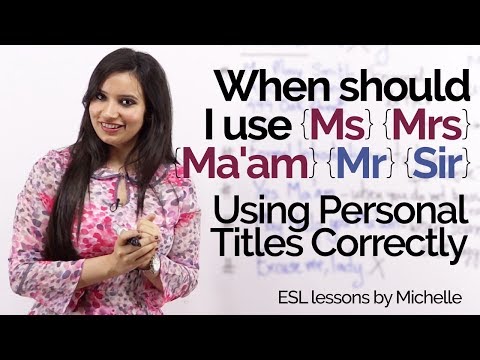
Like many language rules in English, you can use two similar sayings interchangeably. However, it's important to stick to one rule and use that all the time. If you refer to someone as "ma'am" and then say "madam" afterward, it won't seem very formal.
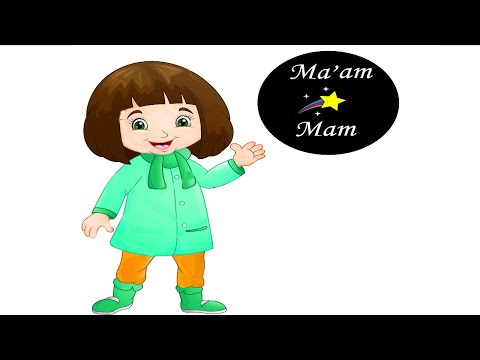
Which Is Correct Ma Am Or Mam Knowing the correct way to address a woman using "madam" teaches us appropriate language skills. That's why it's good to look at the differences between "mam," "ma'am," and "madam" so you can start using them yourself. Ma'am is the short form of madam but we pronounce it as mam. Ma'am is another written form for Madam, which is used to politely or respectfully address a woman.
There is nothing wrong with calling your teacher "ma'am," but you definitely shouldn't call her "mam." Since she's not your mother, "mam" is the incorrect word to use. However, if you want to be respectful, then "ma'am" works perfectly. Now let's look at some examples of using "ma'am." It's the more formal spelling we use when we want to address a superior in some way.
It's reserved for women, as it's a contraction of "madam," which means woman. Both words are used to refer to a female superior officer of some kind. "Ma'am" is the more popular choice of the two, though "madam" still works.

The apostrophe in "ma'am" represents the contraction (the dropped "D" letter). "Mam" is a common word when visiting places like Ireland or Yorkshire in the UK. People use "mam" to address their mother, and it's pronounced the same way it is written.

"Ma'am" elongates the "A" letters in the middle (like "arm") and is used to address a female superior. I would say that "Mom" is the most common with "Mum" being less common but in free variation and "Mam" almost unheard of. The rural western accent tends to pronounce LOT/THOUGHT as a rounded back vowel, while more urban accents tend to be unrounded. Most rurally influenced people also tend to have very back TRAP vowels even before nasals, so the word ma'am sounds like an eastern American Mom or northern English Mam. Personally I say Mom in a way an American might hear as Mawm, and this seems to be quite common, although more urban/general Canadian accents might sound more like the General American variety. I do catch myself saying Mum now and then though.

As for the STRUT vowel it's my opinion that rural westerners tend toward a more back sound especially when being emphatic, while urban accents are more centralised but not necessarily lowered. You've probably been taught to call elders and those in authority by either sir or ma'am (madam is the formal version, but ma'am is more common). Unfortunately, it can be insulting to many people and so I want to challenge you change how you address people.Read More...


No comments:
Post a Comment
Note: Only a member of this blog may post a comment.